
Book Giveaway
Sponsored by Wipf and Stock
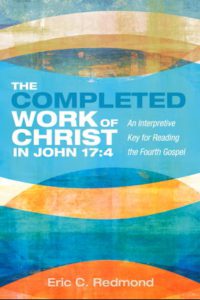
Enter to win a free copy of The Completed Work of Christ in John 17:4 by reposting our X post about the giveaway. Find us on Twitter at @everyvoicekd.
About The Completed Work of Christ in John 17:4
An interview with Eric C. Redmond
EV: What led you to put this book together? What problem or issue(s) are you seeking to address?
ECR: For many years in both academic and pastoral settings, I noticed a nearly universal assumption: when Jesus says in John 17:4, “I have completed the work you gave me to do,” interpreters often treat this as a forward-looking reference to the cross, as though Jesus is speaking proleptically about an event that has not yet occurred. Yet when I examined the verse in its narrative context and considered the perfect verb form used there, it appeared that Jesus was referring to work already fully accomplished.
This raised a significant theological and interpretive question: What work, precisely, does Jesus claim to have completed prior to the crucifixion? That question touches not only Johannine theology, but also our understanding of Christ’s mission as the Agent of redemption sent from the Father. The book is my attempt to address that question with exegetical, literary, and linguistic clarity.
EV: What’s the thesis of your book?
ECR: I argue that in John 17:4, Jesus is referring to the completion of his revelatory ministry—what we commonly identify as the events in Jesus’s Public Ministry (John 1:19-12:50) and Private Ministry (John 13-16)—rather than anticipating the cross. The “completed work” consists of revealing the Father and manifesting His glory throughout Jesus’s earthly ministry. This interpretation is supported by verbal aspect, narrative structure, and John’s theological framework. The crucifixion is not minimized; rather, it is understood as the climactic movement of the same mission, not the sole referent of Jesus’s claim.
EV: Who’s your target audience, and what are you most hoping they hear from it?
ECR: This book is written for several overlapping audiences:
- Professors and students in Biblical Studies, New Testament, Johannine Literature, Greek, and Hermeneutics.
- Researchers interested in verbal aspect theory in Koine Greek.
- Pastors and preachers teaching or preaching through the Gospel of John.
- Lay persons who want to give serious study to the Fourth Gospel as part of their understanding of the person of Christ and his work for the believer.
What I hope they all hear is that careful attention to grammar, genre, and narrative can yield significant theological insight. I also hope they see how Christ’s revelation of the Father is not merely preparation for the cross but an essential part of the saving mission itself.
EV: Did you have any “aha” moments while editing the book?
ECR: Yes—especially when tracing the motif of “glory” across John’s Gospel. As I followed where and how Jesus reveals the Father’s glory before the Passion, I began to see a coherent narrative arc that culminates—but does not begin—in the cross. Recognizing that John presents revelation and redemption as inseparable aspects of one mission helped bring the entire Gospel’s structure into sharper clarity. That was a moment of theological and pastoral illumination for me.
EV: What was the most challenging part of the book project?
ECR: The most challenging portion was articulating the linguistic dimension in a way that was academically responsible yet accessible for pastors and biblical teachers. Discussions of verbal aspect can become technical quickly. I wanted to show how aspect informs meaning in John 17:4 without making the readers feel they needed a graduate seminar in linguistics in order to follow the argument. The task was to balance scholarly rigor with clarity, which is always a careful and rewarding challenge.
EV: If your book was made into a movie, what actor/actress would play the lead role?
ECR: If the “lead role” is Jesus—and Hollywood attempts to convey his patience with John’s “the hour” motif and the meekness with which he approaches God the Father to say that he has fulfilled his mission—I would choose Oscar Isaac. He has a great ability to portray depth, emotional range, and quiet authority—things that would align well with the tone of Jesus’s prayer in John 17.
EV: What kind of seminary/church classes should assign your book?
ECR: The book fits naturally in courses such as:
- Gospel of John / Johannine Literature
- Biblical Hermeneutics
- New Testament Greek Exegesis
- Narrative Interpretation of Scripture
- Preaching from the Gospels
In pastoral contexts, it is especially useful for preaching cohorts, sermon series planning, teaching elder training, as it models how narrative structure and theology shape proclamation. It also would be great for a small group hungering to make a deeper dive into the Gospel of John than what is offered by commonly published curricula or studies guides on the Fourth Gospel.
About the Author

Eric C. Redmond (PhD, Capital Seminary and Graduate School) is a Professor of Bible and Executive Director of the Moody Theological Seminary Center for Compelling Biblical Preaching.