
Book Giveaway
Sponsored by Baker Academics
Enter to win a free copy of Paul for the World by reposting our X post about the giveaway. Find us on X at @everyvoicekd.
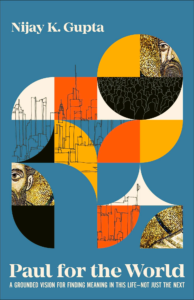
About Paul for the World
An interview with Nijay Gupta
EV: What led you to write this book? What problem or issue(s) are you seeking to address?
NG: I feel like most people I know, including pastors and other Christian leaders, are feeling overwhelmed by the world’s problems: wars, prices, health issues, AI, political divides, and it is tempting to check out and for Christians to go into “autopilot” and wait out the end of the world. I am inspired by Scripture, not to check out waiting for heaven, but to lean in to healing our world, because God’s gospel isn’t just good news for the afterlife—it is good news as we walk in the “newness of life” (Rom 6:4) here and now. God’s plan isn’t to retreat, but to invade and take control away from devil and flesh, sin and death, and anyone and anything that tries to steal, kill, or destroy.
EV: What is the thesis of your book?
NG: Paul’s letters contain mind-blowing theology about God, new creation, salvation, the eschaton, and there is more than good reason to study those subjects (see my book Strange Religion), but what Bible readers often miss is how much of his letters actually are focused on the things that make up our day-to-day lives in this world: work, money, friendship, sports, health, inspiration from the arts. To be Christian is not simply to book our ticket to heaven; it is to know God through Jesus Christ and be transformed by the Spirit to become fully human, yes for eternity, but beginning right here and right now. The gospel’s goal is not to get us to think about different things than this world, but instead to think about this world differently, with the mind of Christ!
EV: Who’s your target audience, and what are you most hoping they hear from it?
NG: I wrote this for people like my students, pastors and thoughtful Christians who want to live out their faith as fully and genuinely and beautifully as they can, day by day. None of us are perfect, Paul was the first to admit that, but we seek to grow more and more into the image of Christ, the only One who can teach us truly how to be human, because he became human for us. If you enjoy books by N.T. Wright, Beth Allison Barr, Carmen Imes, AJ Swoboda, Esau McCaulley, Richard Middleton, Tremper Longman, Mike Bird, I hope you will consider picking this book up to inspire and educate you.
EV: Did you have any “aha” moments while writing the book?
NG: SO MANY! I’ll pick two: first one, sports. Paul uses sports imagery a lot, more than I had known before. He must have been a sports fan, because he found it very inspiring for helping Christians think about facing setbacks, working as a team, challenging yourself, and striving to overcome. Second: the Arts. Paul wove beautiful poetry into his writings, clever wordplay, metaphors from virtually all areas of life (agriculture, architecture, sports, religion, politics, war, music). Sometimes we think that theology is a science: formulas about the Trinity and justification that we have to memorize to face judgment. Yes, theology is important. Yes, Paul was a trustworthy theologian. But Paul was also a creative genius and we could learn some things about growing in our own creativity.
EV: What was the most challenging part of the book to write?
NG: Probably navigating the relationship between the ancient and modern worlds. I want to send a clear message that when we open the Bible we are entering a foreign land, we are engaging in a cross-cultural experience. But we also share with all people throughout time and space some of the same big questions and challenges: what does it mean to be human? Why do we suffer? How can we get along? Where is everything heading?
EV: If your book was made into a movie, what actor/actress would play the lead role?
NG: Hmmm, who should play Paul? Chadwick Boseman if he were still alive, would be amazing. Denzel if he were a bit younger. But I think I gotta go with Pedro Pascal, I am a big Mandalorian fan and Mando is such an extraordinary blend of hard and soft, cautious and caring, responsible and adventurous. #ThisIsTheWay.
EV: What kind of seminary/church classes should assign your book?
NG: My dream is that Paul for the World would be used alongside a more traditional theology of Paul. I think of my book as an “inverted” theology of Paul. Most Pauline theology books focus on salvation, heaven, and the afterlife. My book intentionally focuses on the here and now. I want readers to read my book and say, “Yeah, wait, Paul spends a lot of his time applying gospel thinking and gospel resources to transform life and relationships in the here and now.” I also think about church settings where people just don’t feel like they can relate to Paul. They have been taught that Paul was stuffy, rude, off-putting, and fixated on boring theology. That’s not the real Paul, that’s a sad caricature that gets passed along. The real Paul, the one we read in his letters, is vibrant, inspiring, and his teachings are UBER-RELEVANT to our day-to-day lives not just at church but also at work, at home, and at play. Letting that sink in would transform the church, I have no doubt.
About the Author

Nijay Gupta (PhD, New Testament, University of Durham) serves as professor of New Testament at Northern Seminary. He is the author of numerous books, including A Beginner’s Guide to New Testament Studies, Paul and the Language of Faith, 15 New Testament Words of Life, and Tell Her Story: How Women Led, Taught, and Ministered in the Early Church. He has co-edited The State of New Testament Studies, Dictionary of Paul and His Letters (2nd ed.), and The State of Pauline Studies. Nijay co-chairs the Pauline Theology seminar of the Institute for Biblical Research and serves as a senior translator for the New Living Translation.