
Book Giveaway
Sponsored by Baker Academics
Enter to win a free copy of Contextual Theological Interpretation by reposting our X post about the giveaway. Find us on X at @everyvoicekd.
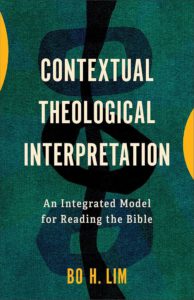
About Contextual Theological Interpretation: An Integrated Model for Reading the Bible
An interview with Bo Lim
EV: What led you to write this book? What problem or issue(s) are you seeking to address?
BL: I’ve told people that I wrote this book for myself. That is, it was written to address my own questions about, and challenges to, reading the Bible and work out my own views and conclusions. I have been committed to both theological interpretation and contextual interpretation, but many consider these approaches incompatible. For me, these concerns are both academic and ministerial and I observed that the discourses in each of these settings did not often take the other into account. I had been working out these concerns through writing articles demonstrating my practice of interpreting texts theologically and contextually, as well as articles devoted to method for several years. When I finally felt capable of penning a coherent and sustained argument I began writing this book.
EV: What is the thesis of your book?
BL: The thesis of the book is that faithful and effective interpretation of the Bible multicultural ecclesial settings must be both theological and contextual. Theological interpretation assumes Scripture to be the elect means to carry out God’s plan of salvation and therefore it operates with theological assumptions and ecclesial resources. Contextual interpretation, which has many definitions, assumes that Scripture is always read through a cultural lens, and seeks to address how it can be read differently based on cultural factors. What both these approaches have in common is that they reject objectivity and are critical of the hegemony of historical criticism. I believe that when one’s theology and ecclesiology are understood multiculturally, these approaches can be integrated.
EV: Who’s your target audience, and what are you most hoping they hear from it?
BL: The book is for both fellow academics as well as advanced undergraduate or graduate students of Scripture. I do care about the church and write for it, but this book was written for ministers engaged in academic discourse. I believe it was necessary to do so because before people interpret the Bible, they should clarify the nature of the task of interpretation. I’m pretty sure many readers will disagree with many of my views in the book – I’m fine with that. But if I can help them clarify for themselves what the role of Scripture is and how it ought to be approached, that’s success.
EV: Did you have any “aha” moments while writing the book?
BL: I had many “aha” moments in the course of my research and writing. Much of the book involved reading in disciplines far afield from my area of expertise which his Old Testament Poetic and Prophetic Literature. I researched based on hunches and read to see whether they were confirmed or corrected. My main hypothesis – that theology is contextual and contextual works assume a theology – was repeatedly confirmed over and over again as I read literature in both disciplines. Another hunch of mine – that theology and context each possesses its limits – was confirmed to me time and time again as I researched each discipline.
EV: What was the most challenging part of writing it?
BL: This is a book that in many ways summarizes years of thinking and writing on the topic. It includes portions of previously written articles on the topic so trying to write a unified and coherent argument was a challenging task.
EV: If your book was made into a movie, what actor/actress would play the lead role?
BL: It’s a book on method. N/A
EV: What kind of seminary/church classes should assign your book?
BL: One professor who leads a DMin program on Contextual Theology expressed to me that this is the book he has been longed for because it outlines all the key issues involved in contextual theology, so certainly classes on contextual interpretation and contextual theology should read this book. I think core theology and core biblical interpretation classes should read this book, but I’ve been around the block enough to know many will remain unconvinced. In addition, it is common for seminary professors to require “diverse sources or authors,” but they provide little guidelines to discern the available resources. Every minister in North America and most places around the world, will have to reflect theologically on multicultural ministry within their congregations. Because of these two factors I’d say every seminarian and minister ought to read the book.
About the Author

Bo Lim (PhD, Trinity Evangelical Divinity School) is a Professor of Old Testament at Seattle Pacific University (SPU), where he has taught since 2006.