
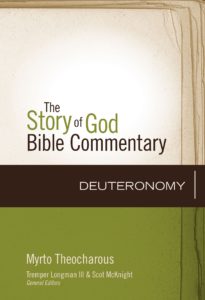
Book Giveaway
Sponsored by Zondervan Academic
Enter to win a free copy of Deuteronomy by reposting our X post about the giveaway. Find us on X at @everyvoicekd.
About Deuteronomy
An interview with Myrto Theocharous
EV: What led you to start researching the book of Deuteronomy?
MT: The beauty and wisdom of the book of Deuteronomy was opened to me early on in my studies by well-respected scholars and friends. There was a lot of prejudice against Old Testament law in the contexts that I grew up, which never really sat well with me. I knew that if God was the author of all these, there must be hints of his character hidden even in the most puzzling of these stipulations. Once I started studying it, I realized that everything that the people of God needed to live the life that God had intended for them was found in Deuteronomy’s pages. Naturally, I was thrilled to have been invited by Zondervan to write a commentary on it, and I immediately accepted.
EV: What are some of the primary themes that stand out to you from the book of Deuteronomy?
MT: The primary theme, I find, in Deuteronomy is the love of God and the love of the neighbour. When Jesus said that the greatest commandment is to love God and then to love your neighbour, he was boiling down the book of Deuteronomy to its very essence. The love and worship of God, in Deuteronomy, passes through the neighbour. He does not require anything for Himself that does not bring life and prosperity to the Other, especially to those who may be easily overlooked. At the same time, it is extremely severe with alternative proposals of love and worship that harm, limit people’s freedom, and re-enslave the self. Other themes include the formation of Israel’s identity through practiced collective memory, but also the forward-looking expectations of land, place, and Israel’s re-creation after exile.
EV: Who’s your target audience, and what’s distinctive about your commentary?
MT: The Story of God Bible Commentary Series is for pastors and students who are looking to see the continuing relevance of the scriptures for the church today. The commentary has enough information for readers who want to understand the ancient Near Eastern world within which many of Deuteronomy’s concepts were received, but also to observe the connections created with the rest of the Christian biblical canon. Ultimately, my target audience are those who read Deuteronomy as Christian scripture and desire to understand its fulfilment in Christ and the Church.
EV: Did you have any “aha” moments while writing the commentary?
MT: I had multiple “aha” moments, but I continue to be struck by what I find to be its greatest mystery. The book moves between two certainties: the certainty of Israel’s failure that is based on multiple pieces of evidence from the people’s past, and, at the same time, the certainty of Israel’s success, victory over all powers, and glorification. I can understand the first certainty very well, but the second certainty is fully unjustified, and, for me, it absolutely necessitates God’s divine intervention for its fulfilment. The author seems to be seeing two Israel’s concurrently, the real and the anticipated ideal one.
EV: What was the most challenging part of writing it?
MT: Apart from the challenge of carving out undistracted time to think, reflect, and write, in the midst of so many demands in our busy lives, in the actual writing process the most challenging parts for me, and the most boring, are always the place names. There is so much debate about ancient locations, specific geographical routes, and their modern correspondents which does not particularly excite me. Another challenge is the decision of what to leave out.
There is so much more that could be said, so much more to include or look at, and one is forced to stop at some point and say, “this will do”.
EV: If Deuteronomy was made into a movie, what actor/actress would play the lead role?
MT: Oh, this is a very hard question. I know that I would definitely want no one else but Terrence Malick to direct it and I would absolutely trust him with the casting.
EV: Why should people consider preaching and teaching from the book of Deuteronomy?
MT: Many Christians have over-emphasized the “great commission”, which is not a biblical expression, at the expense of “the “great commandment”, which is a biblical expression. We are usually concerned for the salvation of people, but we are less concerned and have given less thought and reflection on how a community of salvation looks like in their relationships, practices, processes of fairness, and care for all its members. Deuteronomy teaches that we are not saved by Torah, but we are saved for Torah. The end of salvation is to embody the character of the liberator Christ who brought us out of Egypt and this takes hard work and repetitive practices. By studying, teaching, and preaching Deuteronomy we are called to find ways in our time to live as covenanted people in our communities, which is nothing more than living “in the presence of God”.
About the Author

Myrto Theocharous (PhD, University of Cambridge) is a graduate of the Greek Bible College (Comp. B.Th.) and of Wheaton College, Illinois (M.A. Biblical Exegesis). She teaches Hebrew and Old Testament at The Greek Bible College Athens.