
Book Giveaway
Sponsored by Hodder
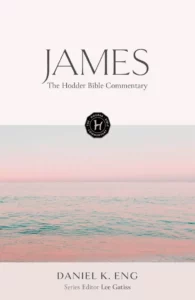
Enter to win a free copy of The Hodder Bible Commentary: James by reposting our X post about the giveaway. Find us on X at @everyvoicekd.
About The Hodder Bible Commentary: James
An interview with Daniel K. Eng
EV: What led you to start researching the book of James?
DKE: James is often preached from because it’s very practical. I discovered that James is relatively under-researched in the New Testament. I remembered my preaching professor, Don Sunukjian, taught how to preach James because of his view on the epistle’s structure. So I set out to investigate the structure further. I appreciate researching James because it’s made me a more well-rounded scholar. In studying James, I had to become more familiar with the words of Jesus, Acts, the Pentateuch, wisdom literature, the prophets, and, of course, Pauline literature.
EV: What are some of the primary themes that stand out to you from the book of James?
DKE: The content of James is consistently grounded in the expectation of end-time judgment. Over and over again, James appeals to this coming judgment to remind the faithful of their hope and to warn the unfaithful of their fate. Also, the epistle is deeply concerned with relationships—both our vertical relationship with God and our horizontal relationships with one another. In this way, James embodies the Great Commandment and the Second Commandment: love for God and love for neighbor.
EV: Who’s your target audience, and what’s distinctive about your commentary?
DKE: My target audience is preachers and Bible study leaders. I do have technical content in it, but I make sure that it’s accessible for the average ministry leader. My commentary is distinctive because I take the stated audience of the epistle, the twelve tribes of the diaspora (1:1), at face value. My exposition centers on how the text speaks to their reality of being socially disadvantaged as minorities with migration in their family history.
EV: Did you have any “aha” moments while writing the commentary?
DKE: I had quite a few, but I’ll name two of them. First, the command to “Draw near to God, and he will draw near to you” (4:8) resonates deeply for a diaspora Jew. With their distance from their homeland and the center of their faith, they would probably be tempted to be ashamed and wonder if they could be in God’s favor. But James emphatically tells that they can still be near to God.
Second, the saying about the “prayer of a righteous man” in 5:16 is not just about prayer in general, but specifically about prayer for healing in the community from sin. This explains why James particularly chose Elijah and his prayer for the rain as the example.
EV: What was the most challenging part of writing it?
DKE: The most challenging part of writing this commentary was having to cut so much good material! I could’ve easily written a commentary that is 3-4 times this size, but I had to stay within the word count to serve our target readers.
EV: If James was made into a movie based on your commentary, what actors/actresses would play the lead roles?
DKE: I’d have Viggo Mortensen play James the teacher, giving his wisdom with quiet conviction. I’d have Adam Driver, who is skilled at portraying characters with internal conflict, play the double-minded man who needs to repent (1:8, 4:8). It’d be fun to see Leonardo DiCaprio play the merchant with worldly ambitions (4:13-14).
EV: Why should people consider preaching and teaching from the book of James?
DKE: James is all about discipleship: how to live as a follower of Jesus. James repeats quite a few of the teachings of his half-brother Jesus, and gives commentary on how his hearers are to live in view of the second coming. He teaches that a “faith” without deeds is dead (2:26), challenging his hearers to pair their vertical faith in God with horizontal love for neighbor. James teaches us how to navigate this awkward age between Jesus’ first coming and his second coming; waiting for the Lord is not a passive state, but an active pursuit of holiness and love.
About the Author

Daniel K. Eng (PhD, University of Cambridge) is an Associate Professor of New Testament at Western Seminary in Portland, Oregon.