
Book Giveaway
Sponsored by Baker Academics
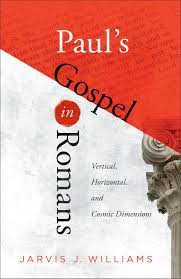
Enter to win a free copy of Paul’s Gospel in Romans by reposting our X post about the giveaway. Find us on X at @everyvoicekd.
About Paul’s Gospel in Romans
An interview with Jarvis J. Williams
EV: What led you to write this book? What problem or issue(s) are you seeking to address?
JW: I wrote the book because I wanted to make a contribution to the ongoing conversations about the gospel in NT scholarship by focusing on Paul’s gospel in Romans.
EV: What is the thesis of your book?
JW: My thesis is Paul’s Gospel in Romans is a vertical, horizontal, and cosmic announcement of good news that God has fulfilled all of his redemptive promises for Jews, for Gentiles, and for the cosmos in Christ and that the foundation of his gospel in Romans is the cross, resurrection, and exaltation.
EV: Who’s your target audience, and what are you most hoping they hear from it?
JW: My primary audience is college, university, and seminary students in biblical studies and theological studies. I secondarily hope NT scholars would benefit from the book too. Thirdly, I think churches with advanced classes in the Bible and theology would benefit from the book.
I want readers of my book to see and hear the following when they read the book. By vertical, I mean Paul’s gospel announces the good news that God has worked through Christ’s death and resurrection to justify sinners by faith, reconcile them to God, and deliver them from the wrath of God (Rom. 1:16-17; 3:21-4:25; 5:6-10). By horizontal, I mean that Paul’s gospel announces the good news that God has worked through Christ’s death and resurrection to transform sinners by the power of the Spirit so that they can live in a godly way in an ungodly society by the power of the Spirit in their love for God and others (Rom 6-7; 12-15). By cosmic, I mean that Paul’s gospel announces the good news that God has worked through Christ’s death and resurrection to set creation free from its enslavement to sin’s power to provide a new creation of the entire world, which only those whom God has justified by faith in Christ alone and transformed by the power of the Spirit will inherit when Jesus returns (Rom. 8:18-25). I also clarify in the book that there is a difference between a Christian sharing the message of the gospel/plan of salvation with a non-Christian and interpreting what is Paul’s “gospel of God” in Romans. The argument of Romans and evidence therein must determine what Paul’s “gospel of God” is in Romans. The message of salvation that Christians share with a non-Christian so that they turn from their sin and would have a personal conversion experience of salvation from their sins and from God’s wrath is the most important news in the world. It’s the good news that if they turn from their sin, since all have sinned and have failed to honor God and since all are guilty before God (1:18-3:20; 323), they will be saved if they believe by faith that Jesus died on the cross for their sins and if they trust by faith that God raised him from the dead for their salvation (Rom. 4:24-25; 10:8-9, 13). This faith in the gospel is a commitment to follow Jesus until the end of one’s life. This message of the good news of salvation for sinners is a vertical announcement. The vertical is the primary and most important in Romans, but there are horizontal and cosmic dimensions of the gospel in Romans too. Paul says his “gospel of God” was “promised in the holy prophets.” Isaiah is an important prophet to help readers of Romans understand his “gospel of God” in the letter. In the book, I show connections between Isaiah and Paul’s gospel in Romans. In Isaiah 40-66, we see vertical, horizontal, and cosmic good news for Jews and Gentiles. Paul says in Romans that what Isaiah promised God fulfilled in Jesus, the Jewish Messiah. Two quick examples of Isaiah in Romans are Isaiah 53 in Romans 4:24-25 and Isaiah 65:17-25 in Rom. 8:18-25.
EV: Did you have any “aha” moments while writing the book?
JW: I learned a lot about Paul’s “gospel of God” in Romans. Perhaps the most illuminating thing I learned was that Paul presents God’s vertical, horizontal, and cosmic good news about Jesus in Romans as the solution to and provision for God’s vertical, horizontal, and cosmic curse in Genesis because of Adam’s transgression.
EV: What was the most challenging part of the book to write?
JW: Paul’s gospel in Romans is a big topic. My book is around 40,000-60,000 words. I found it a challenge to write a short book on the big topic of Paul’s gospel in (what many would say is) his most influential letter.
EV: If your book was made into a movie, what actor/actress would play the lead role?
JW: I have no idea what actor would play the lead role if my book were a movie.
EV: What kind of seminary/church classes should assign your book?
JW: Courses in seminary or college on the NT, NT theology, Pauline theology, Romans, hermeneutics, and theology should consider assigning the book. Advanced church classes on Romans, the gospel, or Paul’s theology should consider assigning the book.
About the Author

Jarvis J. Williams (PhD, The Southern Baptist Theological Seminary) is professor of New Testament interpretation at The Southern Baptist Theological Seminary in Louisville, Kentucky. He is the author of numerous books, including Christ Redeemed ‘Us’ from the Curse of the Law; Redemptive Kingdom Diversity: A Biblical Theology of the People of God; and The Spirit, Ethics, and Eternal Life: Paul’s Vision for the Christian Life in Galatians.