
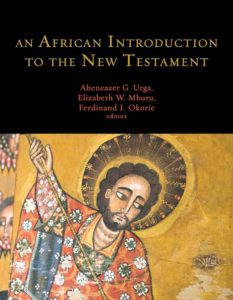
Book Giveaway
Sponsored by Fortress Press
Enter to win a free copy of An African Introduction to the New Testament by reposting our X post about the giveaway. Find us on X at @everyvoicekd.
About An African Introduction to the New Testament
An interview with the Editors
EV: What led you to put this book together? What problem or issue(s) are you seeking to address?
Editors: There are a number of excellent New Testament introductions out there. However, they do not necessarily and explicitly address the deep issues pertaining to the Church in Africa. In most instances, students in Africa use introductory texts that have a Eurocentric orientation.
These are ultimately unable to ask and answer questions that are relevant in the African context. We wanted to address this gap through a contextual framework that seeks to promote the role of context in reading Scripture. That’s why the dialogue between text and context forms an essential component of this book because it allows for interaction with the worlds behind, of, and in front of the text. This volume not only addresses the usual introductory matters: author, date, addressees, purpose, occasion of any given New Testament book, but it also markedly addresses issues like tribalism, politics, economics, prosperity gospel, war, sexual immorality of every kind, poverty, neocolonialism, religious extremism and terrorism, negative ethnicity, kidnapping, etc. At the same time, we recognize that there are good introductory texts already out there so we wanted this volume to be complementary to existing volumes.
EV: What is the thesis of this book?
Editors: Christian Africans can interpret the New Testament texts faithfully and contextually. In other words, the New Testament texts can confirm the good aspects of African cultures and confront and correct cultural elements tainted by the Fall.
EV: Who’s your target audience, and what are you most hoping they hear from it?
Editors: This volume is particularly for students and scholars in Africa. Leaders and ministers in ecclesial contexts are our main audience, but we hope people from the Global North could also benefit from the labors of African New Testament Scholars. As we said in the preface, we hope that our readers grasp the New Testament as authoritative and also relevant and helpful, experiencing God’s transforming power through the Scriptures.
EV: Did you have any “aha” moments while writing the book?
Editors: Yes, we did. As we read through the various chapters, all following the same basic approach but each unique in its own way, we were reminded just how similar the African context is to the biblical context, but at the same time, it has significant differences. The biblical text, for African readers, is therefore both familiar and “other.” We knew that we had to allow this to come through so that our readers would not conflate the two and make the mistake of receiving the biblical text as just another African text. The concept of hospitality, which is such a key part of the African worldview, would be needed to ensure that we guided the authors in maintaining the right balance.
EV: What was the most challenging part of the book to write?
Editors: Perhaps the biggest challenge we had was when a couple of chapters came in and we realized that some of the authors had not really grasped the concept of engaging text and context in a balanced way. We were understandably a little nervous. We knew what we wanted but were not sure if the authors did. We wanted to encourage readers of this volume not to divorce the contextual themes from the biblical context, and also to provide some continuity with existing New Testament volumes from other contexts. But it was not enough to draw parallels between our African contexts and the biblical context. We wanted the authors to interrogate the categories they discovered and then allow the biblical text to determine their validity. This process would allow us to approach the New Testament with familiarity without compromising its otherness. Ultimately, the biblical text holds epistemological authority. It took a little effort, but thankfully, the end product is what we had envisioned.
EV: If your book was made into a movie, what actor/actress would play the lead role?
Editors: If James Earl Jones were still alive, he would have made an excellent narrator.
EV: What kind of seminary/church classes should assign your book?
Editors: An African Introduction to the New Testament is designed for African students in theological institutions and Bible colleges. The most appropriate classes would be New Testament introductory classes but certainly, it can be used for specific book studies even at the postgraduate level. We also believe that it can help both African and non-African readers at all levels understand the various contexts that lie behind the church in Africa.
About the Editors

Abeneazer G. Urga (PhD, Columbia International University) has served as the department head for the MA in Biblical Studies, lectures in biblical studies at the Evangelical Theological College in Addis Ababa, Ethiopia, and is an adjunct professor at Columbia International University and Ethiopian Graduate School of Theology. He is a member of Equip International, SIL Ethiopia/International and associate member of Studiorum Novi Testamenti Societas (SNTS).

Elizabeth W. Mburu was the first woman to gain a PhD from Southeastern Baptist Theological Seminary, North Carolina, USA. She teaches at George Whitfield College in South Africa. Dr. Mburu serves on the editorial teams of the Africa Bible Commentary and the Africa Society for Evangelical Theology. She is also the Africa Regional Coordinator for Langham Literature.

Ferdinand I. Okorie (PhD, Loyola University, Chicago), He is the vice president and academic dean at Catholic Theological Union in Chicago, and also an associate professor of New Testament studies. His research interests include the Greco-Roman context of Early Christianity, the relationship between Paul’s letters and the Pastorals, the formation of Christian identity and the intersection between religion and culture.