
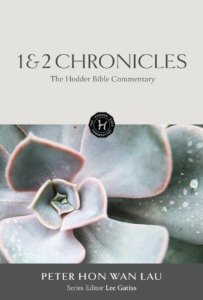
About 1&2 Chronicles
An interview with Peter Lau
EV: What led you to start researching the book of Chronicles?
PL: The project began with an invitation from Lee Gatiss, the editor of the Hodder Bible Commentary series. He approached me because I had already written on Ruth, another Old Testament narrative, and thought those skills would transfer well to Chronicles. But the more time I spent reading, meditating on, and writing about Chronicles, the more fascinated I became by the way it retells Israel’s history for a post-exilic audience. As one of the last books of the Old Testament, Chronicles constantly looks back and reflects on earlier Scripture, and asks what hope remains for God’s people after exile.
EV: What are some of the primary themes that stand out to you from the book of Chronicles?
PL: Over the years, I have become convinced that the overarching theme of Chronicles is God’s kingdom. More specifically, the book seeks to inspire worship and hope in God’s kingdom, centred on David’s line and the temple. Four major themes flow from that purpose:
• The Davidic king and God’s promises to David.
• The temple as the place of God’s presence and rule.
• The identity of God’s people after exile.
• Covenant faithfulness and the consequences of obedience and unfaithfulness.
These themes give readers threads to tie the book together as a whole.
EV: Who’s your target audience, and what’s distinctive about your commentary?
PL: I wrote the commentary with a global audience in mind: pastors, Bible study leaders, theological students, and curious Christians who want help reading Chronicles well. My own teaching has shaped that instinct, since I have taught students in Malaysia and Australia, and have recently taught in South Africa as well. This commentary tries to combine careful scholarship with clear application. I wanted to take the historical and literary context seriously while also helping readers move from Chronicles to Christ, and from Christ to contemporary Christian living. Because I often teach across cultural contexts, I am attuned to honour-shame dynamics and questions of social identity where they arise clearly from the passage. Another distinctive feature of the Hodder Bible Commentary series is that contributors interact, at points, with the reception of the text among the early Church Fathers. Most importantly, throughout the commentary I use a biblical-theological approach that connects Chronicles to the larger story of Scripture.
EV: Did you have any “aha” moments while writing the commentary?
PL: One of my biggest “aha” moments was recognising how closely Chronicles links the temple and the Davidic king. A key text is 1 Chronicles 17:14, where God says of David’s descendant, “I will set him over my house and my kingdom forever.” The temple and kingdom are intertwined throughout the book. The temple symbolises God’s royal presence among his people and gives concrete expression to Davidic kingship. That connection points forward beautifully to Jesus Christ, who is both the true temple and the ultimate Davidic king.
EV: What was the most challenging part of writing it?
PL: The biggest challenge was the discipline of reading Chronicles on its own terms. Most readers are more familiar with Samuel and Kings, and it is easy to let those books dominate our interpretation. The Chronicler deliberately selects, reshapes and arranges material to make particular theological points. I had to resist the temptation to treat Chronicles as an appendix to Samuel and Kings and instead ask what this inspired author wanted his readers to see. Helping modern readers appreciate that distinctive perspective was one of the hardest and most rewarding aspects of the project.
EV: If Chronicles was made into a movie based on your commentary, what actors or actresses would play the lead roles?
PL: Since I’ve just watched The Odyssey, I’m going to plunder its cast. Matt Damon would be David, though Chronicles gives us a more idealised David than the conflicted Odysseus figure. Robert Pattinson could be Solomon: brilliant, dazzling and slightly mysterious, although in Chronicles his darker side from Kings stays mostly off-screen. Lupita Nyong’o would be an excellent Queen of Sheba, with the intelligence and royal presence needed for someone who comes to test Solomon and leaves praising the God who blessed him. Tom Holland could play Josiah, the earnest young reformer. Still, Chronicles would need unusual billing. The human kings may dominate the screen, but the real protagonist is God himself, whose faithfulness carries the story from Adam to Cyrus and beyond.
EV: Why should people consider preaching and teaching from the book of Chronicles?
PL: Chronicles is one of the most neglected books in the Old Testament, which is precisely why it deserves more attention. However, the more important reason is that Chronicles gives the church a unique perspective on faithful worship, disappointed hopes and the enduring promises of God. It helps Christians understand how the Old Testament story moves toward Christ. It raises questions about kingship, temple, covenant, worship, and God’s people that are answered in the New Testament. It also speaks directly to believers who feel discouraged, weak, or uncertain about the future. The original audience had returned from exile to a difficult reality, and Chronicles encouraged them to place their hope in God’s promises. That remains a timely message for the church today.
EV: How was writing a commentary on Chronicles similar and different to writing a commentary on Ruth?
PL: Both books ultimately point readers to God’s faithfulness and to his larger redemptive purposes. They also anticipate kingship: Ruth ends by looking forward to David, while Chronicles looks back to David’s line to sustain hope for God’s kingdom after exile. Both require careful attention to literary structure, theological themes, and their place within the biblical storyline. There are also substantial differences. Ruth is a short, tightly constructed narrative that can be read in a single sitting. Chronicles is comprised of sixty-five chapters, covers centuries of history, and engages constantly with earlier biblical texts. Writing on Ruth involved close attention to a single story; writing on Chronicles required tracing patterns, themes, and intertextual connections across vast stretches of Scripture. I also found that Ruth often draws readers in immediately through its compelling characters and plot, whereas Chronicles rewards patient study. I hope my commentary draws readers into this rich, relevant, and often-overlooked book.
About the Author

Peter Lau (PhD, University of Sydney) is a Lecturer at Seminari Theoloji Malaysia, Equip Gospel Ministries (Malaysia), and Sydney Missionary and Bible College.